Analysis
Utilities to aid in performing and evaluating image registration.
This module provides functions to compute displacements of image coordinates under a transformation, useful for assessing the accuracy of image registration processes.
References
Power, JD. et al. (2012). “Spurious but systematic correlations in functional connectivity MRI networks arise from subject motion.” NeuroImage, 59(3):2142-2154. doi:10.1016/j.neuroimage.2011.10.018.
- nitransforms.analysis.utils.DEFAULT_FD_RADIUS = 50.0
Default radius (in mm) of a sphere where framewise displacements are calculated. The choice was proposed by [Power2012], and it represents approximately the mean distance from the cerebral cortex to the center of the head.
- nitransforms.analysis.utils.compute_fd_from_motion(motion_parameters: ndarray, radius: float = 50.0) ndarray[source]
Compute framewise displacement (FD) from motion parameters.
The framewise displacement is the sum of the magnitudes of the translational and rotational motion, computed from the frame-to-frame differences along the three spatial axes [Power2012].
Each row in the motion parameters represents one frame, and columns represent each coordinate axis
x, y`, andz. Translation parameters are followed by rotation parameters column-wise.- Parameters:
- Returns:
The framewise displacement (FD) at each timepoint as the L1 norm of frame-to-frame displacement across translations and rotation-derived displacements.
- Return type:
:raises exc:ValueError: If
motion_parametersis not a 2D array with shape(T, 6).
- nitransforms.analysis.utils.compute_fd_from_transform(img: SpatialImage, xfm: TransformBase, xfm_prev: TransformBase | None = None, radius: float = 50.0, n_vertices: int = 8) float[source]
Compute the framewise displacement (FD) for a given transformation.
This implementation varies with respect to the original formulation by [Power2012] in that the FD is computed as the average across a number of vertices sampled over the sphere. See
sample_unit_sphere()for details about the vertex sampling method.For
n_vertices == 1, FD is computed from rigid-body parameter increments (translation L1 + radius-scaled rotation L1) instead of averaging displacements over sampled sphere points. Seecompute_fd_from_motion()for direct comparability.- Parameters:
img (
SpatialImage) – The reference image. Used to extract the center coordinates.xfm (
TransformBase) – The transformation to test. Applied to coordinates around the image center.xfm_prev (
TransformBase, optional) – A previous transformation to compare with. IfNone, the identity transformation is assumed (no transformation).radius (
float, optional) – The radius (in mm) of the spherical neighborhood around the center of the image.n_vertices (
int, optional) – The number of vertices to sample on the sphere.
- Returns:
The average framewise displacement (FD) for the test transformation.
- Return type:
:raises exc:ValueError: If
n_vertices < 1.
- nitransforms.analysis.utils.displacements_within_mask(mask_img: SpatialImage, xfm: TransformBase, xfm_prev: TransformBase | None = None) ndarray[source]
Compute the distance between voxel coordinates mapped through two transforms.
- Parameters:
mask_img (
SpatialImage) – A mask image that defines the region of interest. Voxel coordinates within the mask are transformed.xfm (
TransformBase) – The transformation to test. This transformation is applied to the voxel coordinates.xfm_prev (
TransformBase, optional) – A previous (reference) transformation to compare with. IfNone, the identity transformation is assumed (no transformation).
- Returns:
An array of displacements (in mm) for each voxel within the mask.
- Return type:
- nitransforms.analysis.utils.euler_from_matrix(affine: ndarray, degrees: bool = True) ndarray[source]
Extract XYZ Euler angles from affine or rotation matrices using SciPy.
ndarrayArray of shape (…, 3), Euler angles in ‘xyz’ convention.
ValueErrorIf
affinedoes not end with shape(3, 3)or(4, 4).
- nitransforms.analysis.utils.extract_motion_parameters(affine: ndarray) Tuple[ndarray, ndarray][source]
Extract translation (mm) and rotation (degrees) parameters from an affine matrix.
- nitransforms.analysis.utils.sample_unit_sphere(n_points: int = 8) ndarray[source]
Returns \(N\) evenly distributed points on a unit-radius sphere.
This function returns a deterministic, quasi-uniform point set on the surface of the unit sphere \(S^2 \subset \mathbb{R}^3\).
Notes
There is no unique notion of “evenly distributed” for arbitrary \(N\) on a sphere. This function uses:
Platonic solids for certain small \(N\) (high symmetry; e.g. \(N = 6\) gives the \(\pm\) axis points).
A Fibonacci / golden-angle spiral otherwise (fast, simple, good coverage).
- Parameters:
n_points (
int) – Number of points on the sphere.- Returns:
An array of shape
(n_points, 3)whose rows have unit norm.- Return type:
- Raises:
TypeError – If
n_pointsis a boolean or not an integer type.ValueError – If
n_points < 1.
Examples
Basic shape + unit norm:
>>> import numpy as np
>>> values = (1, 2, 8, 10, 12, 20)
>>> for n_pts in values:
...     X = sample_unit_sphere(n_pts)
...     X.shape, bool(np.allclose(np.linalg.norm(X, axis=1), 1.0))
((1, 3), True)
((2, 3), True)
((8, 3), True)
((10, 3), True)
((12, 3), True)
((20, 3), True)
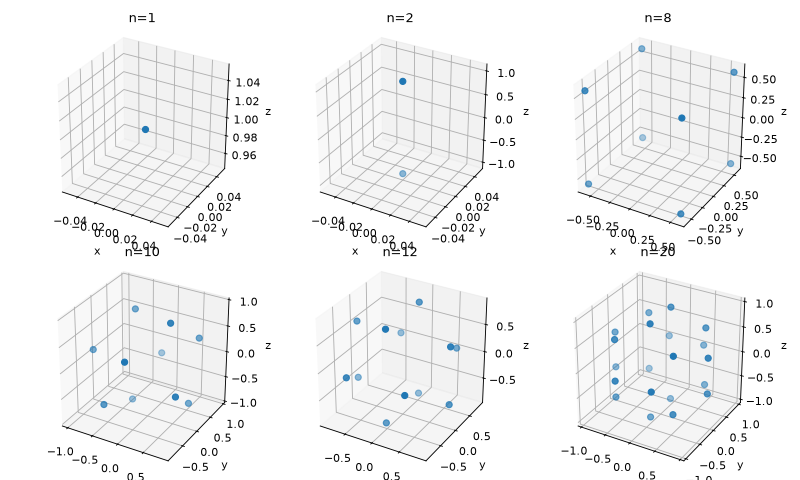
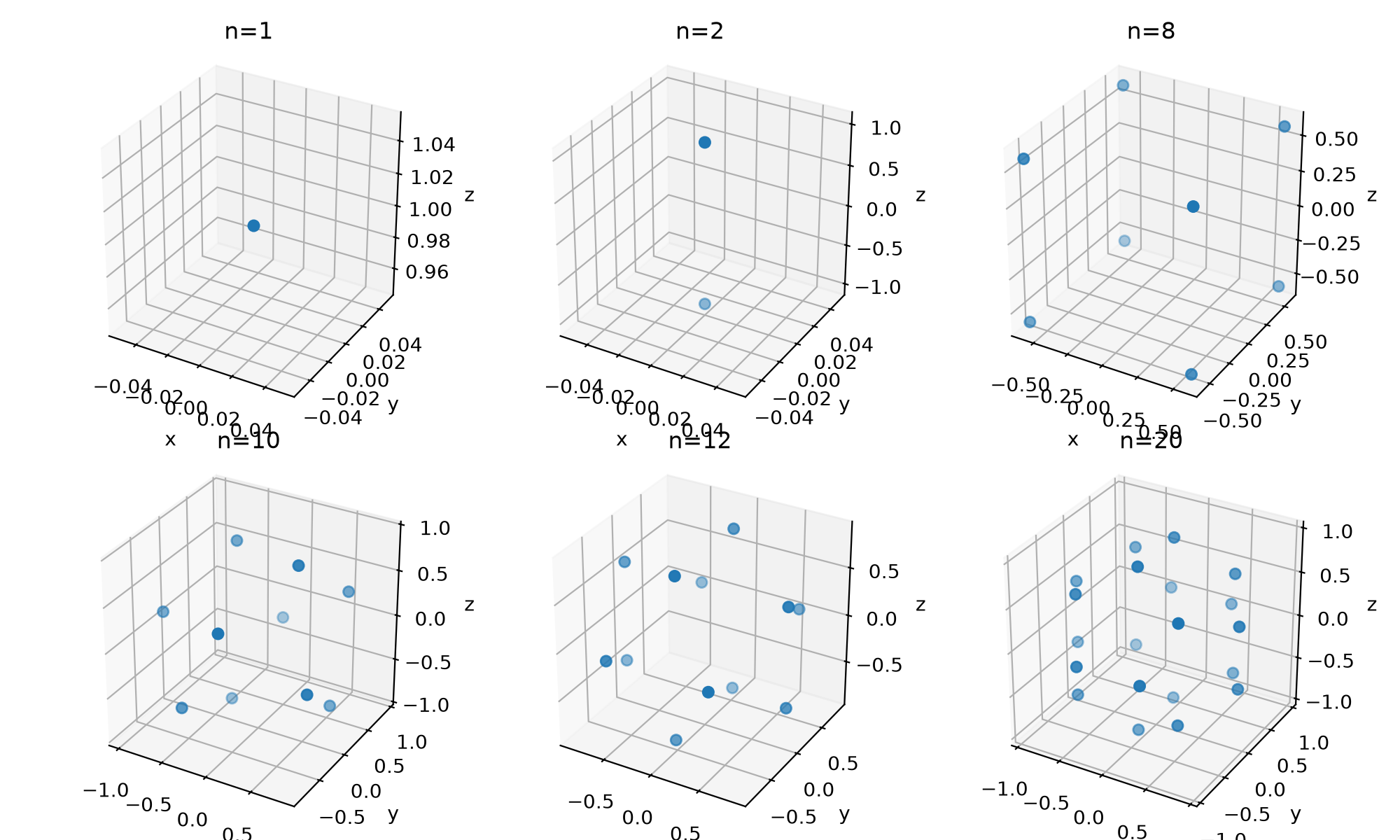
Visualization of sampled points for each case:
import numpy as np
import matplotlib.pyplot as plt
import mpl_toolkits.mplot3d

from nitransforms.analysis.utils import sample_unit_sphere

values = (1, 2, 8, 10, 12, 20)

fig = plt.figure(figsize=(10, 6))
for i, n_pts in enumerate(values, start=1):
    X = sample_unit_sphere(n_pts)
    ax = fig.add_subplot(2, 3, i, projection="3d")
    ax.scatter(X[:, 0], X[:, 1], X[:, 2], s=30)
    ax.set_title(f"n={n_pts}")
    ax.set_xlabel("x")
    ax.set_ylabel("y")
    ax.set_zlabel("z")
    ax.set_box_aspect((1, 1, 1))
fig.tight_layout()
(
Source code,png,hires.png,pdf)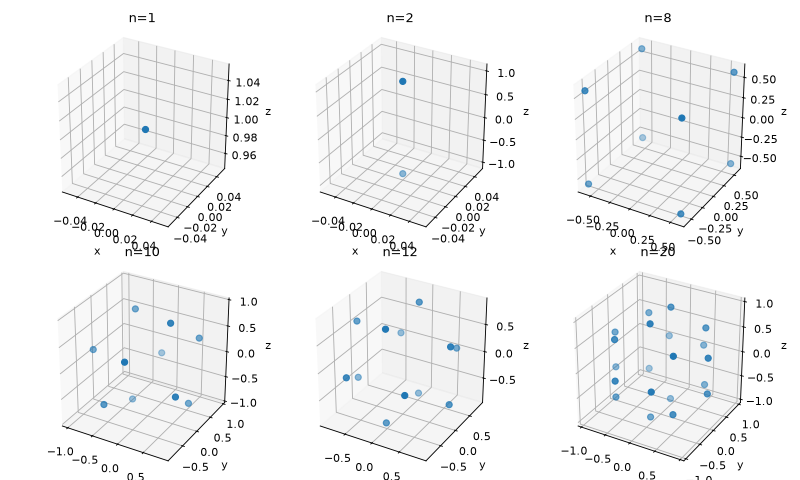
For \(N = 6\), return the \(\pm\) axis points (octahedron vertices):
>>> X = sample_unit_sphere(6)
>>> # Each row has exactly one coordinate with magnitude 1, others 0
>>> bool(np.all((np.abs(X) == 1.0).sum(axis=1) == 1))
True
>>> bool(np.all((np.abs(X) == 1.0).sum(axis=0) == 2))  # each axis appears twice (±)
True
For \(N = 4\), the tetrahedron has constant pairwise dot product -1/3 off-diagonal:
>>> X = sample_unit_sphere(4)
>>> D = X @ X.T
>>> off = D[~np.eye(4, dtype=bool)]
>>> bool(np.allclose(off, -1/3))
True
For a quasi-uniform set, the second moment matrix is close to
I/3, and the minimum angular separation is non-trivial:>>> X = sample_unit_sphere(200) >>> M = (X.T @ X) / len(X) >>> bool(np.allclose(M, np.eye(3) / 3, atol=1e-3)) True >>> def min_angle_rad(Y): ... dots = np.clip(Y @ Y.T, -1.0, 1.0) ... np.fill_diagonal(dots, 1.0) ... ang = np.arccos(dots) ... np.fill_diagonal(ang, np.inf) ... return float(ang.min()) >>> min_angle_rad(X) > 0.18 True
Improper inputs:
>>> sample_unit_sphere(True)
Traceback (most recent call last):
...
TypeError: n_points must be a positive integer
>>> sample_unit_sphere(0)
Traceback (most recent call last):
...
ValueError: n_points must be 1 or greater